Seasonal Climate Data and Corresponding Planting Technical Parameters of Yunnan and Guizhou Tobacco Regions in China
In the landscape of southwestern tobacco cultivation, although Yunnan and Guizhou are both located in the subtropical monsoon climate zone, the subtle differences in their climate parameters determine completely different agronomic logic. As a technician who has been working in the fields for over twenty years, I deeply understand: reading the sky for tobacco planting means not reading the weather forecast, but the sets of rainfall and temperature curves that determine the fate of the plants.
1. "Character Differences" between Yunnan and Guizhou: A Battle between Scorching Sun and Clouds
The foundation of the Yunnan tobacco region (mainly southern and central Yunnan) is "intense". The sunlight here is extremely strong, and the day-night temperature difference can often remain above 10°C. This temperature difference guarantees high-quality tobacco leaves because it promotes the accumulation of organic substances. However, this comes with extreme seasonal precipitation.
In contrast, the Guizhou tobacco region is more like a "moist" container. With more clouds, high humidity, and although sunlight is not as direct as in Yunnan, temperature fluctuations are relatively gentle. The challenge here is not extreme high temperatures, but the lingering high humidity that remains above 80% for extended periods.
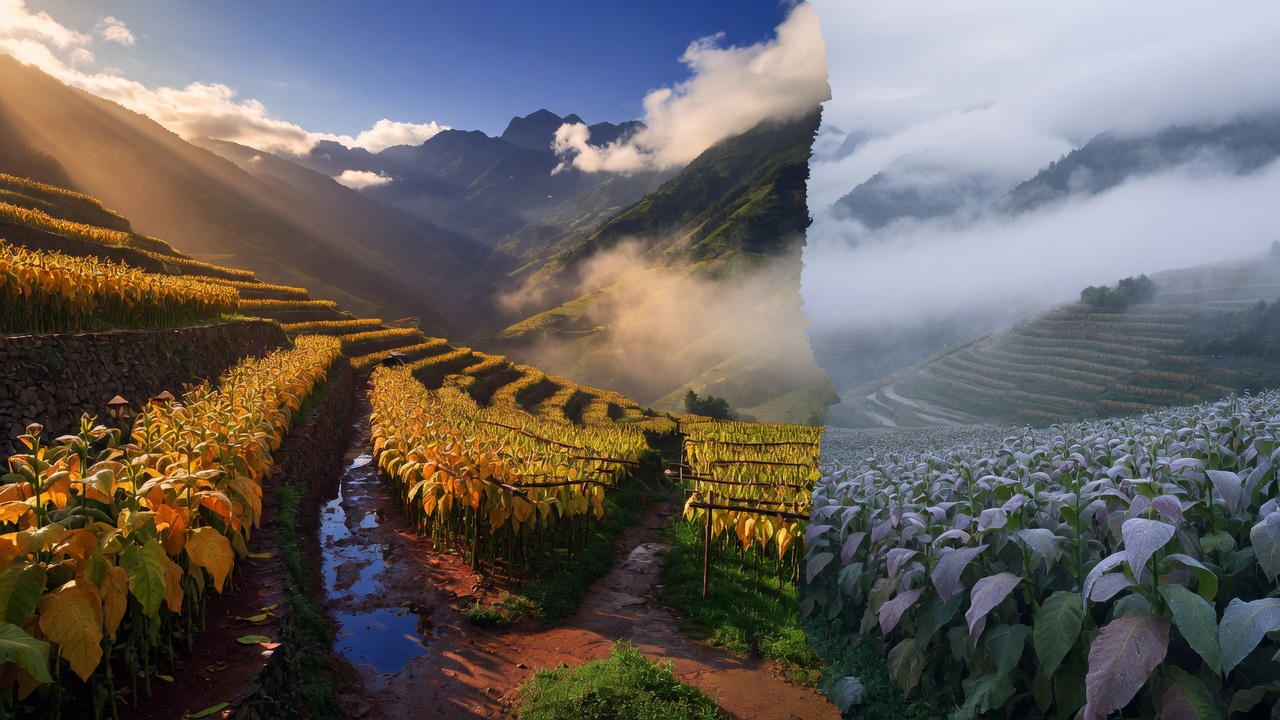
Yunnan vs Guizhou: Cultivation Strategy Comparison
Yunnan
Climate Base: Strong sun, large ΔT
Rainfall: Extreme seasonal
Topping Logic: Race against time
Harvest: Dry window (<50mm/month)
Core Goal: Control rainy season
Guizhou
Climate Base: High humidity, stable
Rainfall: High frequency, even
Topping Logic: Avoid risks, sunny days
Harvest: Anti-mold (T+humidity)
Core Goal: Use windows, combat humidity
2. Core Climate Parameters Driving the Growth Cycle
2.1 Yunnan: Dealing with Precipitation Peaks and Temperature Difference Dividends
In Yunnan, the key to the growth cycle lies in precise prediction of the "rainy season".
- Summer (June-August): This is the peak of precipitation, often exceeding 250mm per month. Temperatures generally remain between 26°C and 32°C.
- Practical Experience: I recall an area in Xishuangbanna where in July of one year, we encountered 15 consecutive days of heavy rainfall. The soil water content became saturated instantly, and the plants showed obvious "excessive growth" phenomena, with roots even showing slight browning due to hypoxia. In such a situation, continuing conventional fertilizer and water management would be equivalent to "feeding" the pests and diseases.
- Autumn (September-November): The rainy season ends, temperatures begin to drop, and the day-night temperature difference widens. This is the critical period when tobacco leaf quality transitions from "quantity" to "quality".
2.2 Guizhou: "Chronic" Growth in a High-Humidity Environment
The climate parameters of Guizhou are characterized as "high humidity, stable temperature, weak light".
- Full Growth Cycle: Although precipitation distribution is not as extreme as in Yunnan, the frequency of precipitation is extremely high.
- Temperature Characteristics: Although summer temperatures also reach around 25°C, effective photosynthetic radiation time is short due to cloud cover. This causes the growth rhythm of Guizhou tobacco to be slightly slower than Yunnan, and leaf maturity often lags behind.
3. The Key to Success: Timing Logic of Topping
Topping is not a fixed date, but a dynamic decision based on climate parameters.
In Yunnan, the topping logic is "race against time":
Due to the intense summer rainy season in Yunnan, once plants enter the period of excessive vegetative growth, topping must be performed during rainfall gaps. If continuous rainy weather occurs, plants will stretch upward vigorously. Without timely topping, nutrients will be largely consumed at the top, causing the bottom economic leaves to become too thin and too soft. My experience: observe the precipitation curve; once there are 3-5 consecutive days without rain and with sufficient sunlight, that is the optimal window for topping.
In Guizhou, the topping logic is "avoiding risks":
The problem in Guizhou lies in "humidity". Due to high humidity year-round, wound healing after topping is much slower than in Yunnan. If topping is performed on a cloudy day with dense fog, wounds are easily infected by pathogens, leading to whole plant withering. Therefore, in Guizhou, I prefer to operate on days with stable temperatures and predictable continuous sunny weather, preferring to slightly delay rather than taking risks.
4. Seizing the Harvest Window: Technical Parameters of Harvesting
Harvesting is a race against natural precipitation.
- Yunnan's "Dry Window":
Yunnan's harvest period usually follows closely after the rainy season ends. We need to monitor the time point when precipitation drops below 50mm per month. At this time, due to sufficient sunlight and dry air, water in the leaves can quickly convert through physiological metabolism into substances, and the Leaf Moisture Content after harvest is also more easily controlled within the ideal range.
- Guizhou's "Anti-Mold Window":
In Guizhou, the core parameters of harvesting are "temperature difference and humidity". We must complete harvesting within the brief window when autumn temperatures drop to 15°C - 18°C and humidity begins to decline. If harvested during continuous autumn rain, the water content of tobacco leaves in the field is too high, not only making harvesting difficult but also easily causing mold during the drying process, directly affecting the grade.
5. Technical Summary
Growing tobacco is essentially achieving a dynamic balance with local climate patterns. Yunnan must "adapt to temperature differences and control the rainy season"; Guizhou must "utilize windows and combat high humidity". Mastering the logic behind these climate parameters is the only way to guard that golden quality in the face of unpredictable nature.